By Krystal Meldrum
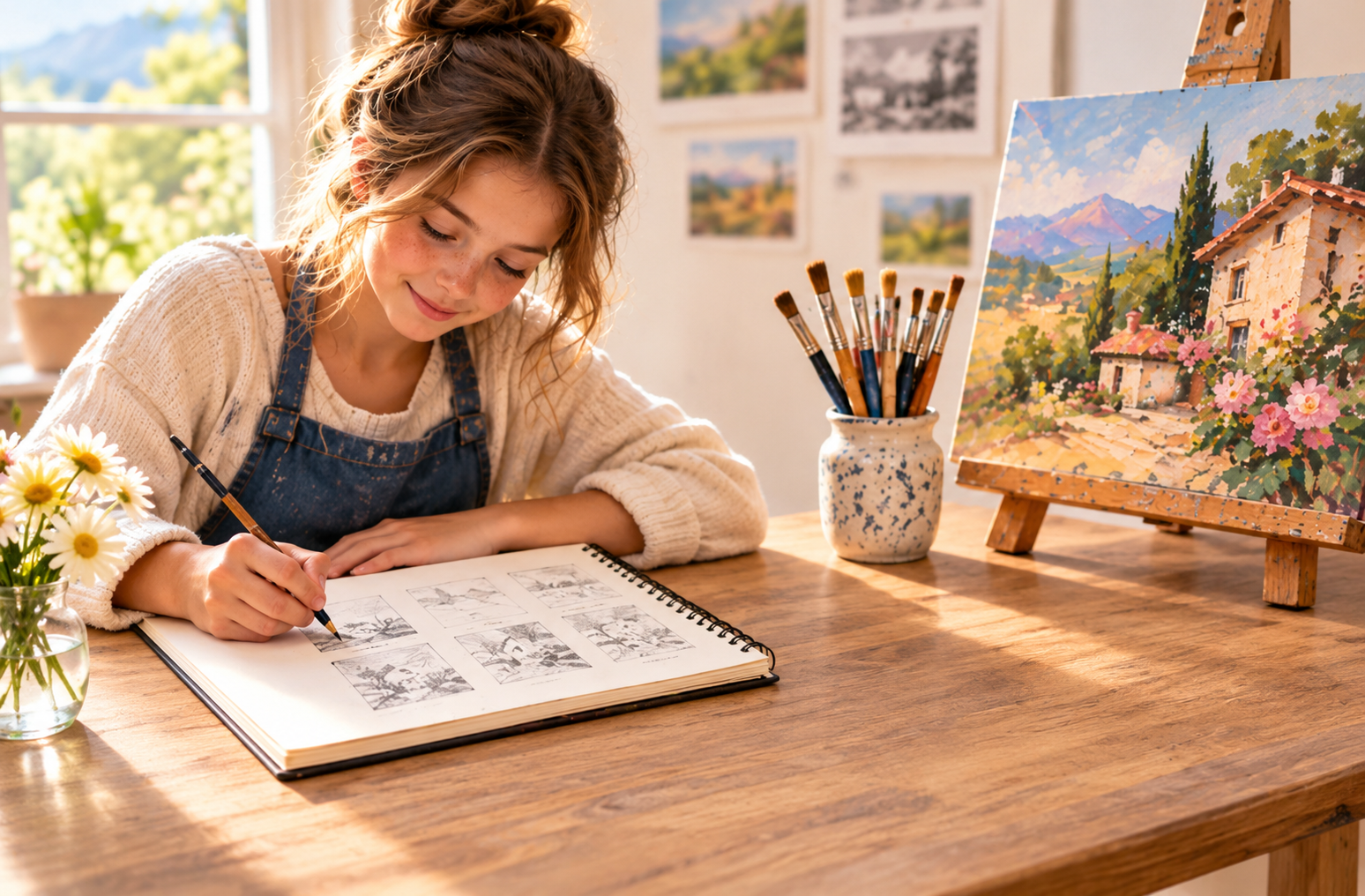
A beautiful painting is wonderful. But learning how to think like an artist is even better!
When teaching homeschool art lessons, don't feel like every project needs to end with a Pinterest-worthy masterpiece.
Give your children permission to experiment.
Make thumbnail sketches. Try different colors. Paint something that doesn't work. Ask why. Change it. Paint over it. Try again! The majority of my acrylic paintings have 3 completely different paintings. I’m thrifty. I just keep painting a new acrylic painting on the canvas until I make a good one.
That's the creative process!
It’s important to develop more than just painting skills. Artists are designers, creative thinkers, problem-solvers, visual communicators, and innovators.
Show Your Work—Even in Art!
Great artists think before they paint.
In math, students work out their calculations. In English, they write drafts. Why should art be any different?
I want you to make thumbnail sketches, do research, find reference images, make value studies, color experiments, and revisions.
These steps help your ideas develop.
Perhaps a thumbnail shows that the composition is too crowded. A value study reveals that the focal point disappears. A color experiment creates an entirely different mood.
Wonderful! We learned something before spending 30 hours on a painting!
Every step teaches us something.
Art Teaches Critical Thinking and Problem-Solving
Ask questions. Discover solutions.
Creating artwork requires constant decision-making.
What am I trying to communicate? Where should the focal point go? Which colors best express my message? What could I improve?
Students develop creativity, communication, collaboration, and problem-solving skills as they work through the artistic process.
In professional settings, artists often collaborate with art directors, designers, and clients who provide feedback throughout a project.
Learning to accept critiques, revise artwork, and explain artistic decisions prepares students for real creative careers.
Art Is a Language Without Words
Every artistic choice communicates.
My college professor, artist Leon Parson, once said something I'll never forget: “If it don't communicate, it ain't art!”
Think about that!
A painting can communicate peace, courage, grief, beauty, faith, or joy without a single written word.
The composition communicates.
The colors communicate.
The shadows communicate.
Even the brushstrokes communicate!
Sometimes the message is obvious. Other times, it's mysterious or open to interpretation.
But artists make intentional choices to influence what viewers see, think, feel, and learn.
Your Next Masterpiece Begins With an Idea!
Think. Experiment. Create. Improve.
Grab a sketchbook. Sharpen your pencils. Set out the paints.
Encourage your young artist to try something new, make mistakes, and discover what works.
Remember, the goal isn't simply to finish a beautiful painting.
It's to develop the skills to create a lifetime of masterpieces!
Explore inspiring, step-by-step homeschool drawing and painting lessons at ArtDreamer Academy | OrganizeYourJoy.com.