By Krystal Meldrum
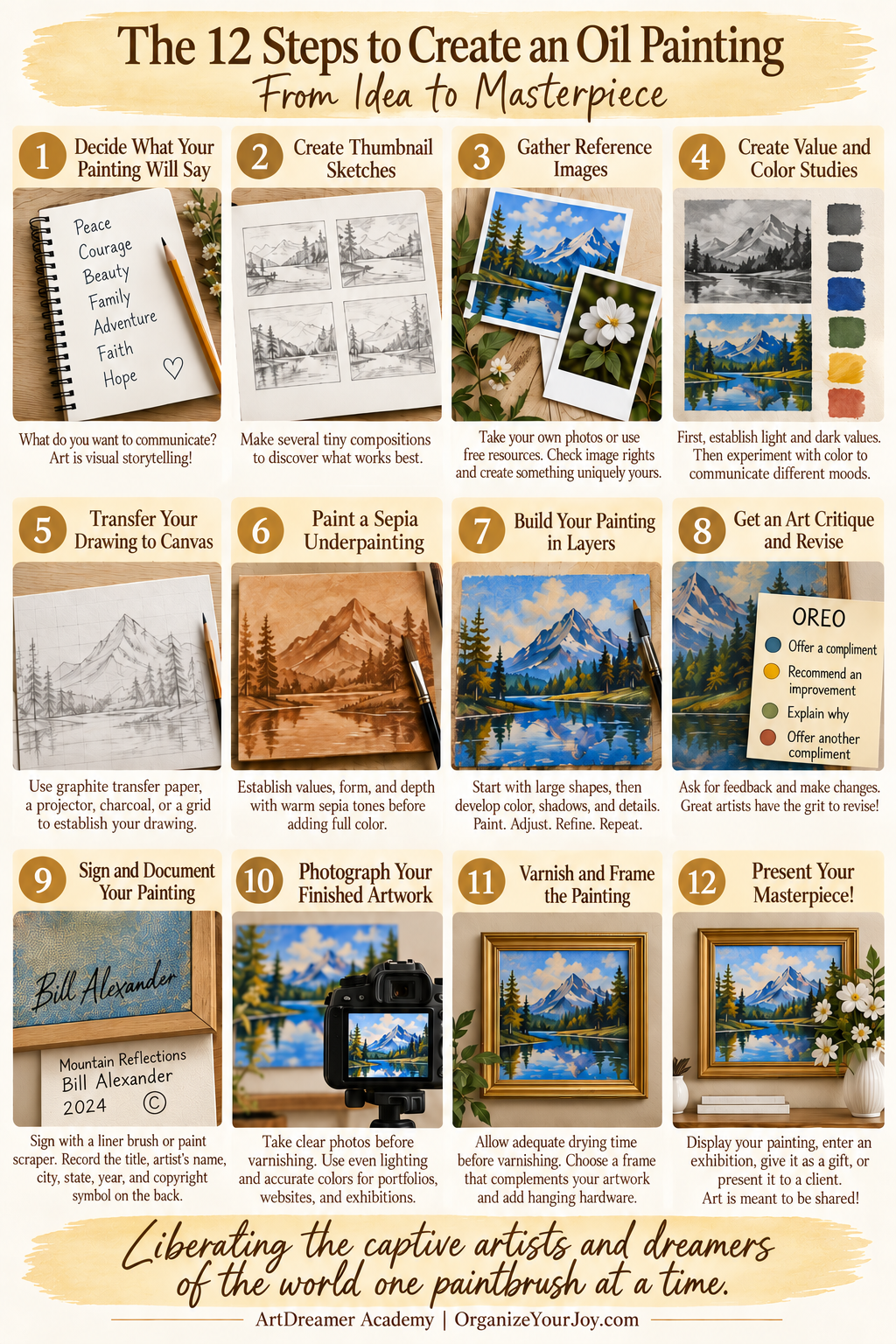
A masterpiece doesn't begin with a paintbrush. It begins with an idea worth communicating!
One of my favorite things to teach students is that professional artists don't simply paint. They brainstorm, experiment, solve problems, revise, and present their work.
As my college professor Leon Parson used to say, “If it don't communicate, it ain't art!”
I teach my students 12 steps to creating an oil painting, helping them develop the skills to turn their imagination into something meaningful.
Great Artists Show Their Thinking
Plan with purpose. Create with confidence.
In English, students write drafts. In math, they show their calculations. Why should art be any different?
The 8th Grade Visual Art Standard VA.1.8a encourages students to document their creative process visually or verbally.
I want students to show how their ideas grow from tiny sketches into beautiful paintings. Each step helps them discover new possibilities and make thoughtful artistic decisions.
The 12 Steps to Creating a Masterpiece
From imagination to inspiration!
Find Your Message. What do you want your painting to communicate? Brainstorm themes and ideas.
Sketch Your Ideas. Create thumbnail sketches, experiment with compositions, and ask for feedback.
Gather References. Take photographs, study objects, and collect visual inspiration.
Study Values & Colors. Experiment with light and dark, high-key or low-key values, and color combinations that establish mood.
Transfer Your Drawing. Use graphite paper, charcoal transfer, or a projector to establish your composition on canvas.
Create an Underpainting. Paint in warm sepia tones to establish form, light, and shadow.
Paint Your Masterpiece. Build oil paint over your underpainting, developing colors, textures, and details.
Critique & Revise. Invite constructive feedback and make improvements.
Sign & Document. Sign your artwork and record the title, artist's name, location, year, and copyright symbol on the back.
Photograph Your Painting. Capture your artwork before varnishing to avoid glare.
Varnish & Frame. Allow adequate drying time before applying an appropriate varnish. Choose a frame and hanging hardware that complement your painting.
Present Your Masterpiece! Display it, deliver it to a client, enter a gallery, or store it safely.
These steps teach more than painting techniques. They teach planning, patience, critical thinking, and professional presentation.
Learn the Rules So You Can Break Them!
Master the foundations. Discover your freedom.
The High School Advanced Visual Arts Standard VA.2.IIIa encourages students to explore materials, methods, and artistic conventions—including when to break them.
I love that!
Artists need to understand the principles of design before they can intentionally experiment with them.
Some students may only take one art class with me. I can't teach them everything, but I can give them a strong foundation for future artistic adventures.
My hope is that they leave knowing how to think like designers, whether they're painting a portrait, illustrating a book, or starting a creative business.
Art Is Visual Communication
Make something beautiful. Say something meaningful.
A painting can communicate courage, faith, humor, love, or hope without a single written word.
But artists also need to explain their ideas to clients, fellow artists, and designers.
That's why I emphasize communication, critical thinking, and problem-solving throughout the creative process.
A successful artist learns not only how to make something beautiful but also how to communicate a message, collaborate with others, and explain artistic decisions.
Every Masterpiece Begins With One Step!
Dream it. Plan it. Paint it. Share it!
I want my students to develop the confidence to create artwork that is beautiful, thoughtful, and meaningful.
They don't have to master everything today. They simply need to begin, practice, and keep growing.
💙 Art is not a talent, it’s a skill that anyone can learn!
Explore step-by-step drawing and painting lessons at ArtDreamer Academy | OrganizeYourJoy.com.