By Krystal Meldrum
MAKE YOUR ART POP, YOUNG ARTIST! 🎨
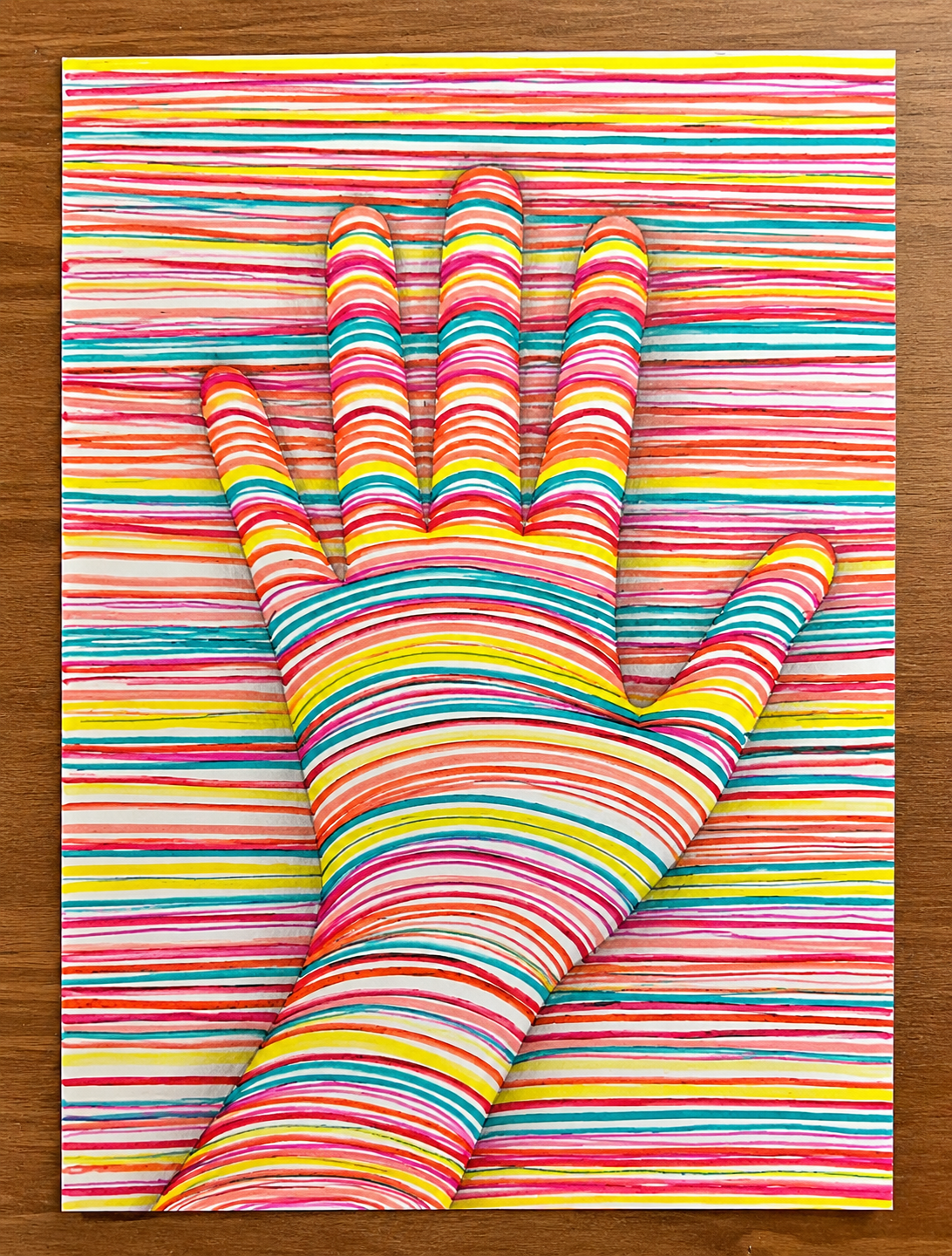
Can you believe a flat piece of paper can trick your eyes into seeing something three-dimensional?
With a pencil, colorful markers, and a little imagination, you can create an amazing 3D hand optical illusion!
This easy art project introduces children to Op Art (Optical Art), a fascinating art style that uses lines, patterns, colors, and contrast to create visual illusions.
It's a wonderful activity for homeschool art lessons, classroom art projects, and beginning artists who want to explore something new.
Simple lines. Brilliant colors. BIG illusions!
What Is Op Art?
Art can play tricks on your eyes!
Op Art is short for Optical Art. Artists use carefully arranged lines, shapes, colors, and patterns to create surprising visual effects.
Sometimes a flat picture appears to move. Other times, shapes seem to bend, ripple, or jump right off the page!
One famous Op Art artist, Bridget Riley, explored how repeating patterns and contrasting colors can create a sense of movement.
The exciting thing about Op Art is that you don't need expensive supplies or advanced drawing skills to experiment with it.
Just a few simple lines can create something extraordinary!
How Does a 3D Hand Illusion Work?
Straight lines stay flat. Curved lines create dimension!
The secret to this drawing is surprisingly simple.
When you draw straight horizontal lines across the background, your paper looks flat.
But when those lines reach the outline of your hand, you curve them upward and over the fingers and palm.
Suddenly, the hand appears to rise above the paper!
Your brain interprets the curved lines as a three-dimensional surface.
By repeating this pattern with different colors, you create an exciting optical illusion.
It's a wonderful introduction to how artists use contour lines, repetition, rhythm, and visual perception.
Your Art Challenge: Create a 3D Hand Drawing!
One hand. A handful of markers. Endless possibilities!
Gather Your Supplies
You'll need:
White drawing paper
Pencil and eraser
Black marker
Colorful markers or colored pencils
Ruler (optional)
Step 1: Trace Your Hand ✋
Place your hand flat on the paper with your fingers spread comfortably apart.
Use a pencil to trace around your hand.
Keep your pencil lines light so they're easy to erase later.
Step 2: Draw Straight Lines 📏
Begin drawing horizontal lines across the background.
When you reach your hand outline, stop!
Continue the straight line on the other side of your hand.
Leave the inside of your hand empty for now.
Step 3: Make Your Hand POP!
Here's where the magic happens!
Connect the background lines across your hand using gently curved lines.
Imagine each line traveling up and over a rounded surface.
The more carefully you curve your lines, the stronger your 3D illusion becomes!
Try to keep the lines evenly spaced.
Step 4: Add Brilliant Colors! 🎨
Choose your favorite marker colors and begin tracing the lines.
Experiment with rainbow colors, alternating warm and cool colors, or creating a repeating color pattern.
You can even use black and white for a dramatic optical illusion!
Step 5: Step Back and Look! 👀
Hold your artwork at arm's length.
Does your hand look like it's floating above the paper?
If the illusion isn't strong enough, look closely at your curved lines.
Are they rounded over the fingers and palm?
Make adjustments and watch your artwork come to life!
What Are Children Learning?
Fun art projects can teach BIG artistic concepts!
This simple optical illusion drawing introduces several important foundational art skills.
Line: Straight and curved lines communicate different forms.
Shape and Form: A flat hand shape begins to appear three-dimensional.
Pattern and Rhythm: Repeated lines and colors create visual movement.
Contrast: Different colors and values help strengthen the illusion.
Problem-Solving: Students experiment with their lines to discover what makes the illusion work.
Most importantly, children discover that art isn't just about copying what they see.
It's about understanding how and why visual effects work!
That's what it means to think like an artist.
Make It Your Own!
Learn the technique. Then let your imagination soar!
Once you've mastered the 3D hand illusion, experiment with new possibilities.
Try tracing a heart, a leaf, a butterfly, or another simple shape.
Change the direction of your lines.
Explore different color combinations.
Can you make your shape appear to rise higher above the paper?
Can you create the illusion of something sinking into the page instead?
Every experiment teaches you something new.
Creativity grows when we give ourselves permission to play!
Your Hurdle Helper: Start With Just Five Lines!
Does a whole page of colorful patterns feel overwhelming?
Don't worry about finishing the entire project today.
Trace your hand and draw just five lines.
That's it!
Tomorrow, add five more.
Little creative habits lead to BIG artistic discoveries.
Progress over perfection!
Every Child Can Become an Artist!
The beauty of this project is that anyone can try it.
You don't need to be a talented illustrator or an experienced painter.
You simply need curiosity, a few basic supplies, and a willingness to experiment.
Art education helps children develop observation, patience, creativity, and confidence.
And sometimes the most exciting lessons begin with something as simple as tracing your hand!
So grab your markers, explore those curves, and make your artwork POP!
💙 Art is not a talent, it’s a skill that anyone can learn!
Looking for more creative art projects?
Discover beginner-friendly online art classes for kids, homeschool art curriculum, step-by-step drawing lessons, and painting tutorials at ArtDreamer Academy | OrganizeYourJoy.com.