By Krystal Meldrum
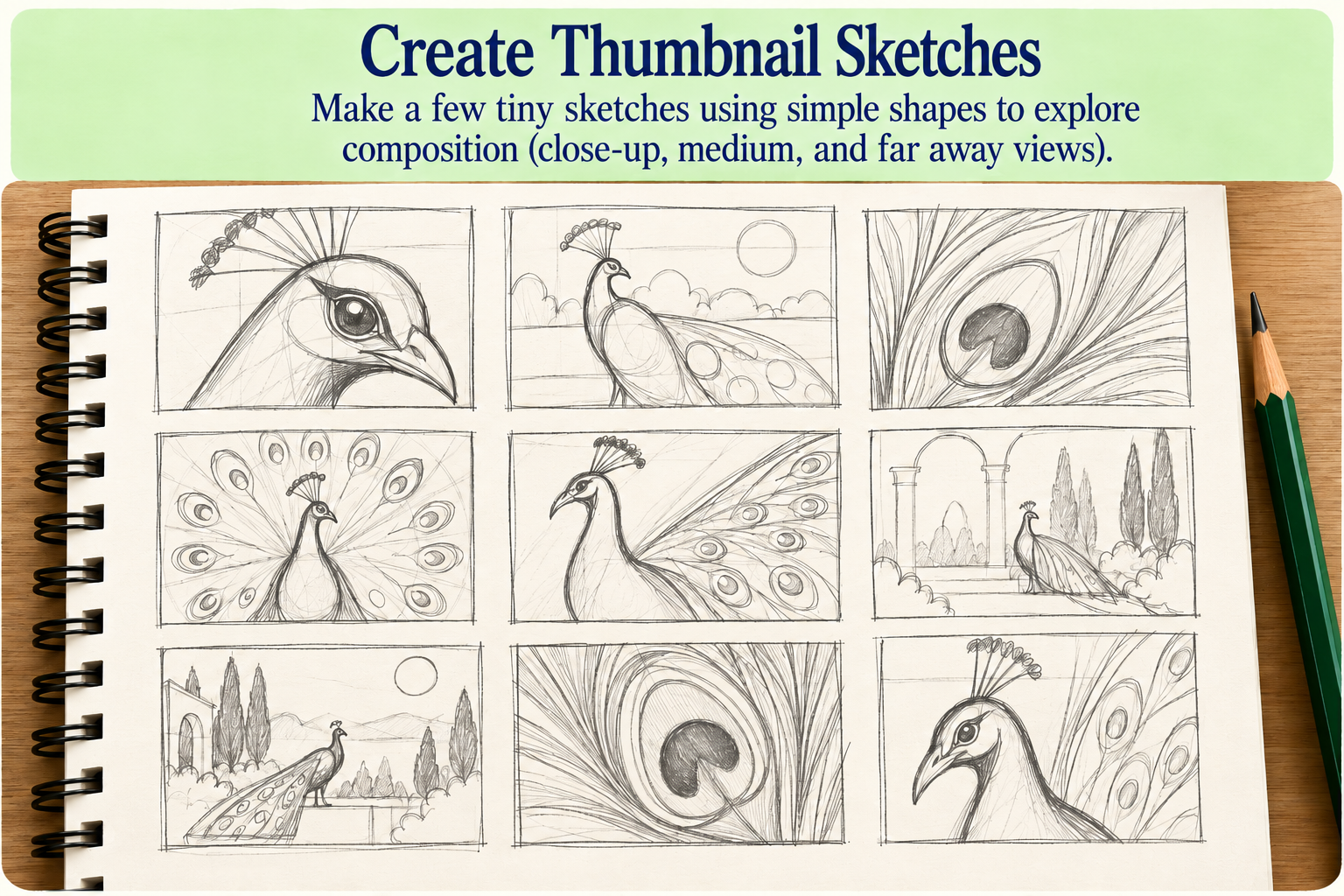
Big masterpieces begin with tiny ideas! 🎨
Have you ever started a painting, only to discover halfway through that something doesn't look quite right? Perhaps your subject is too small, your background is too busy, or your composition feels unbalanced.
Here's a little secret artists use to solve these problems before picking up a paintbrush.
Thumbnail sketches!
These tiny pencil drawings take just a few minutes, but they can make a BIG difference in your artwork.
Whether you're teaching homeschool art lessons, learning to draw, or beginning your first painting, thumbnail sketches help you plan your composition and bring your creative ideas to life.
Start With a Message, Not a Masterpiece!
Before you begin drawing, ask yourself one important question:
What do I want my artwork to communicate?
Perhaps you want to capture the beauty of nature, tell a story, express a feeling, or share something meaningful.
Your message is the heart of your masterpiece!
Once you know what you want to say, it's time to explore how to say it visually.
That's where thumbnail sketches come in.
What Is a Thumbnail Sketch?
A thumbnail sketch is a tiny, quick pencil drawing used to plan a painting's composition before adding details.
Think of it as a little roadmap for your artwork!
You don't need perfect proportions, beautiful shading, or fancy drawing skills.
Just simple shapes, loose lines, and a BIG idea!
Thumbnail sketches help artists experiment with the arrangement of subjects, backgrounds, light, and dark areas.
And because they're small, you can try several different ideas without spending hours drawing.
One Idea. Many Possibilities!
Imagine you're planning a painting of a beautiful peacock.
You could draw the peacock in several different ways.
Close-Up: Zoom in on the peacock's face or the beautiful patterns of its feathers.
Medium View: Show the peacock's body and some of its magnificent tail.
Faraway View: Place the peacock in a garden surrounded by trees, flowers, or architecture.
Each composition tells a slightly different story!
The close-up emphasizes details. The medium view celebrates the bird. The faraway view introduces the environment.
Same subject. Different compositions. Different feelings!
This is why professional artists explore multiple ideas before committing to a final painting.
Your Art Challenge: Create 4–6 Thumbnail Sketches!
Ready to give it a try?
Grab a pencil, a piece of paper, and your imagination!
Step 1: Choose Your Subject
Pick something you'd love to paint. It could be an animal, a castle, a landscape, or a beautiful bouquet of flowers.
Step 2: Draw 4–6 Small Rectangles
These little boxes will become your thumbnail sketches.
Step 3: Set a Timer for 1–3 Minutes
Keep your drawings quick and simple!
Use circles, ovals, triangles, and loose lines to explore your ideas.
Step 4: Experiment With Composition
Try placing your subject close up, in the middle distance, and far away.
Move your focal point around. Experiment with large and small shapes.
Notice how each arrangement changes the feeling of your artwork.
Step 5: Explore Light and Dark
Squint at your reference photo and identify the largest light and dark areas.
Shade these areas simply to see how contrast helps your subject stand out.
Step 6: Choose Your Favorite!
Compare your sketches.
Which composition best communicates your message?
Which one catches your eye?
You've just made an important artistic decision!
Why Thumbnail Sketches Are Wonderful for Kids
One of my favorite things about teaching thumbnail sketches is that they encourage children to experiment without worrying about perfection.
A tiny sketch feels manageable.
There's no pressure to create a finished masterpiece.
Instead, children learn to explore, make decisions, solve problems, and trust their creative instincts.
They also discover that their first idea isn't always their best idea!
Creativity grows when we give ourselves permission to experiment.
For homeschool families and art teachers, thumbnail sketches are a wonderful warm-up activity before beginning larger drawing or painting projects.
They're inexpensive, require very few supplies, and can be completed in just minutes.
Your Hurdle Helper: Think Small Before You Paint BIG!
Feeling overwhelmed by a blank canvas?
Don't begin with the entire painting.
Begin with one tiny rectangle!
Spend just two minutes exploring an idea.
Then try another.
Remember, thumbnail sketches aren't supposed to be beautiful. They're supposed to help you THINK!
A little planning today can save hours of frustration tomorrow.
Every Masterpiece Begins With an Idea!
Learning to create thumbnail sketches is one of the foundational skills that helps beginning artists develop confidence and creativity.
The more you practice exploring compositions, the easier it becomes to turn your imagination into beautiful artwork.
So before you begin your next masterpiece, remember:
Dream it. Sketch it. Explore it. Paint it!
💙 Art is not a talent, it’s a skill that anyone can learn!
Ready to grow your artistic skills?
Discover beginner-friendly online art classes, step-by-step drawing lessons, painting tutorials, and homeschool art curriculum at ArtDreamer Academy.
ArtDreamer Academy | OrganizeYourJoy.com