10 Easy Art Lessons for Homeschool Kids
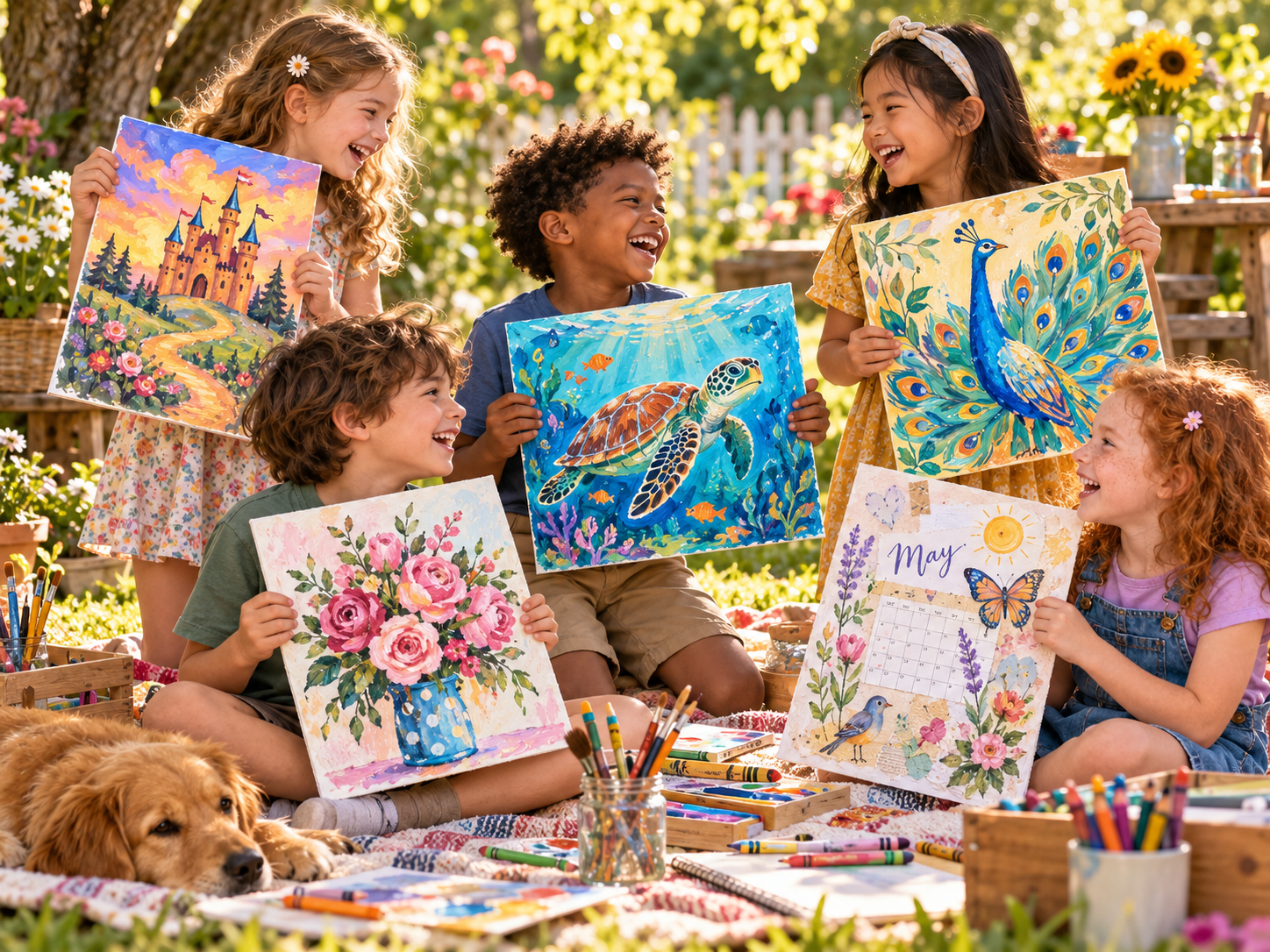
Art class at home doesn’t need to involve an expensive supply list—or a parent who knows how to draw.
Some of the best art lessons begin with things you probably already have: a pencil, a box of watercolors, crayons, paper, or a few tubes of acrylic paint. The secret is choosing projects that look exciting but can be broken into manageable steps.
Here are 10 ideas that let kids draw, paint, experiment, and make something they’re proud of along the way.
1. Turn a Calendar Into Art
Give your child an ordinary calendar and let each month become a new mini masterpiece.
Add scrapbook paper, photographs, doodles, watercolor, stickers, lettering, or collage. January might be snowy blues while May explodes with flowers.
Besides being fun, decorating a calendar sneaks in lessons about color, composition, focal points, and mixed media. Kids can also use it to track a tiny creative habit— even two minutes of drawing a day counts!
2. Watercolor Your Family Recipes
Instead of another sheet of watercolor paper, give kids something they can actually use: recipe cards.
Paint tiny berries, leaves, vines, flowers, dots, and borders around favorite family recipes. Beginners can discover that five simple dots suddenly become a flower.
When they’re finished, they haven't just practiced watercolor—they've created something worth keeping or giving away.
3. Try Watercolor Magic
Hand your child a white crayon, watercolor paints, and table salt and let a little art magic happen.
Draw first with the white crayon, then brush watercolor over the top to reveal the hidden design. Sprinkle salt into wet paint and watch new textures appear.
Without realizing it, kids are experimenting with resist, gradients, wet-on-wet painting, and texture.
4. Build an Elephant From Shapes
How do you draw a giant elephant?
Don’t start with an elephant. Start with an oval.
Add another shape for the baby, curved lines for trunks, and simple forms for the waterfall and tropical plants. Once everything is in place, add wrinkles, shadows, and details.
This lesson helps children discover one of drawing’s best-kept secrets: big, complicated subjects can be broken into simple shapes.
5. Go Underwater With Turtle Tide
Paint a mama and baby sea turtle gliding through colorful ocean water.
Begin with the turtles’ largest shapes and slowly build the underwater world around them. Add gradients, glazing, bubbles, coral, highlights, and shadows.
Kids have enough guidance to succeed but plenty of freedom to invent their own ocean.
6. Paint Flowers Without Painting Every Petal
Flowers don't have to be complicated.
Start with spirals, circles, and curved brushstrokes and turn them into a playful bouquet of roses. Put them inside a polka-dot vase and experiment with large, medium, and small shapes.
Along the way, kids explore color mixing, highlights, shadows, composition, and focal point—without worrying about creating a botanically perfect flower.
7. Turn Simple Shapes Into a Peacock
A peacock's tail may look intimidating, but simplify it and suddenly it becomes doable.
Begin almost like you're drawing half of a daisy. Then layer yellow, green, turquoise, blue, and purple to create those spectacular feathers.
It's a colorful way to practice patterns, gradients, acrylic layering, highlights, and composition.
8. Capture a Mother Hen and Her Chicks
This cozy animal project is perfect for kids who love nature.
Instead of drawing hundreds of individual feathers, look for the big shapes first. Then use marks, shadows, warm colors, and texture to suggest the feathers.
The result can feel detailed without requiring your young artist to draw every detail they see.
9. Invent a Fairytale Castle
This is where drawing meets storytelling.
Start with towers, trees, clouds, roses, a road, or perhaps a tiny carriage. Then ask:
Who lives here? Where does that road lead? What happens beyond the castle walls?
Children can design their own sky, landscape, colors, and magical details while practicing drawing, composition, and acrylic painting.
10. Travel to India With a Pencil
For an older child or one ready for a challenge, try drawing a garden scene featuring the Taj Mahal, peacocks, flowers, trees, and a reflection pool.
Don't tackle the entire picture at once. Lightly establish the largest shapes and guidelines first, then work through the drawing section by section.
The finished piece introduces graphite shading, texture, value, composition, and one-point perspective while showing kids how manageable a complicated artwork becomes when they slow down and build it in stages.
The Goal Isn't an Easy Picture
The goal of beginner art isn't to make everything easy.
It's to make the next step feel possible.
A child can learn genuine drawing and painting skills without beginning with projects that leave them frustrated. Start small, teach one skill at a time, and let success give them the courage to try something harder.
One pencil becomes a sketch.
One brushstroke becomes a painting.
And one finished project can make a child begin to believe:
“Maybe I really am an artist.”
At ArtDreamer Academy at OrganizeYourJoy.com, my step-by-step art lessons help young artists build real skills through projects they’re excited to create.
Because artists aren't born knowing how to make art. They learn by making it.