Why Your Child Says “I Can’t Draw”—and How to Build Artistic Confidence
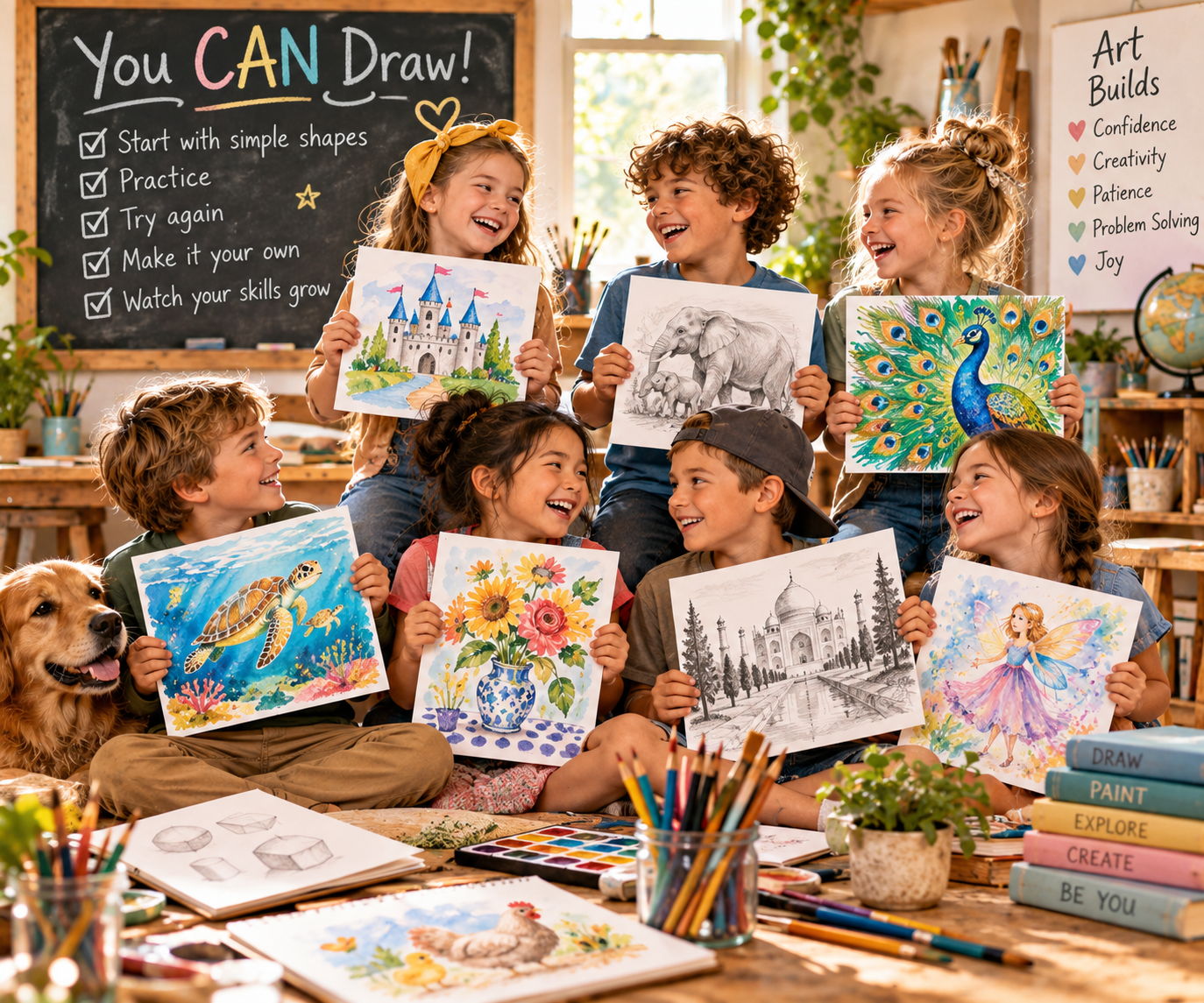
If your child says, “I can’t draw,” they may not actually mean they cannot draw.
They may mean:
“I don’t know where to start.”
“This doesn’t look like I imagined.”
“Someone else is better than me.”
“I’m afraid I’ll mess it up.”
Learning how to teach kids to draw is often less about giving them more instructions and more about helping them feel safe enough to keep trying.
Start With Simple Shapes
A complicated drawing becomes much easier when kids learn to break it into basic shapes.
A turtle can begin with an oval.
A castle can begin with rectangles and triangles.
An elephant can begin with a large oval, a smaller head shape, and simple legs.
When children see the “bones” of a drawing first, they stop feeling like they have to create the finished artwork all at once.
Let the First Lines Be Light
Many kids press hard because they think the first line needs to be correct.
Teach them to sketch lightly.
Light lines can be erased, moved, and adjusted.
That simple habit teaches something important:
Artists revise.
A drawing does not have to begin perfectly to become beautiful.
Stop Comparing Finished Art
One of the quickest ways to lose artistic confidence is to compare a beginner’s work with someone else’s finished artwork.
Instead, compare your child’s drawing with their own earlier work.
Ask:
What did you learn this time?
What part looks stronger?
What would you try differently next time?
Progress is much more motivating than perfection.
Praise the Process, Not Just the Picture
Instead of only saying, “That looks beautiful,” notice what your child actually did.
Try:
“You really looked carefully at those shapes.”
“I love how you kept going when that part was hard.”
“You tried a darker value there, and it gave the drawing more depth.”
“You changed your idea instead of giving up.”
This helps kids understand that becoming an artist is about practice, observation, and persistence.
Use Step-by-Step Drawing Lessons
If you are wondering how to teach kids to draw when you do not consider yourself artistic, step-by-step lessons can help.
You do not have to know everything yourself.
A good drawing lesson gives your child enough structure to feel successful while still leaving room for creative choices.
You can learn beside them.
That can actually make art feel safer.
Let Them Make “Bad” Art
Not every page needs to be frame-worthy.
Kids need sketchbooks where they can experiment, make mistakes, scribble, erase, and try again.
The more pressure there is to make something “good,” the harder it can be to create freely.
Sometimes the best thing you can say is:
“This one is just practice.”
Build Confidence Through Small Wins
Do not begin with the hardest project you can find.
Start with something your child can finish.
Then build.
One successful drawing can become two.
Two can become a habit.
A habit can become real skill.
That is how artistic confidence grows.
A Gentle Place to Begin
When your child says, “I can’t draw,” try replacing it with:
“You can’t draw it yet.”
Start with one shape.
Keep the lines light.
Practice one skill at a time.
Then keep going.
Your child does not need to be born an artist.
They become one by creating.
At ArtDreamer Academy, our step-by-step homeschool drawing lessons are designed to help beginners build real skills, confidence, and creativity without the pressure to be perfect.