4 Benefits of Art Education for Kids: Building GRIT
Art is more than creating beautiful pictures. It prepares children for life!
Homeschool art lessons do more than teach kids to draw and paint. Art education builds creativity, confidence, character, and lifelong learning skills.
We teach children to read words because words have power. We should also teach them to understand and create images—because images can influence what we believe, value, buy, and become.
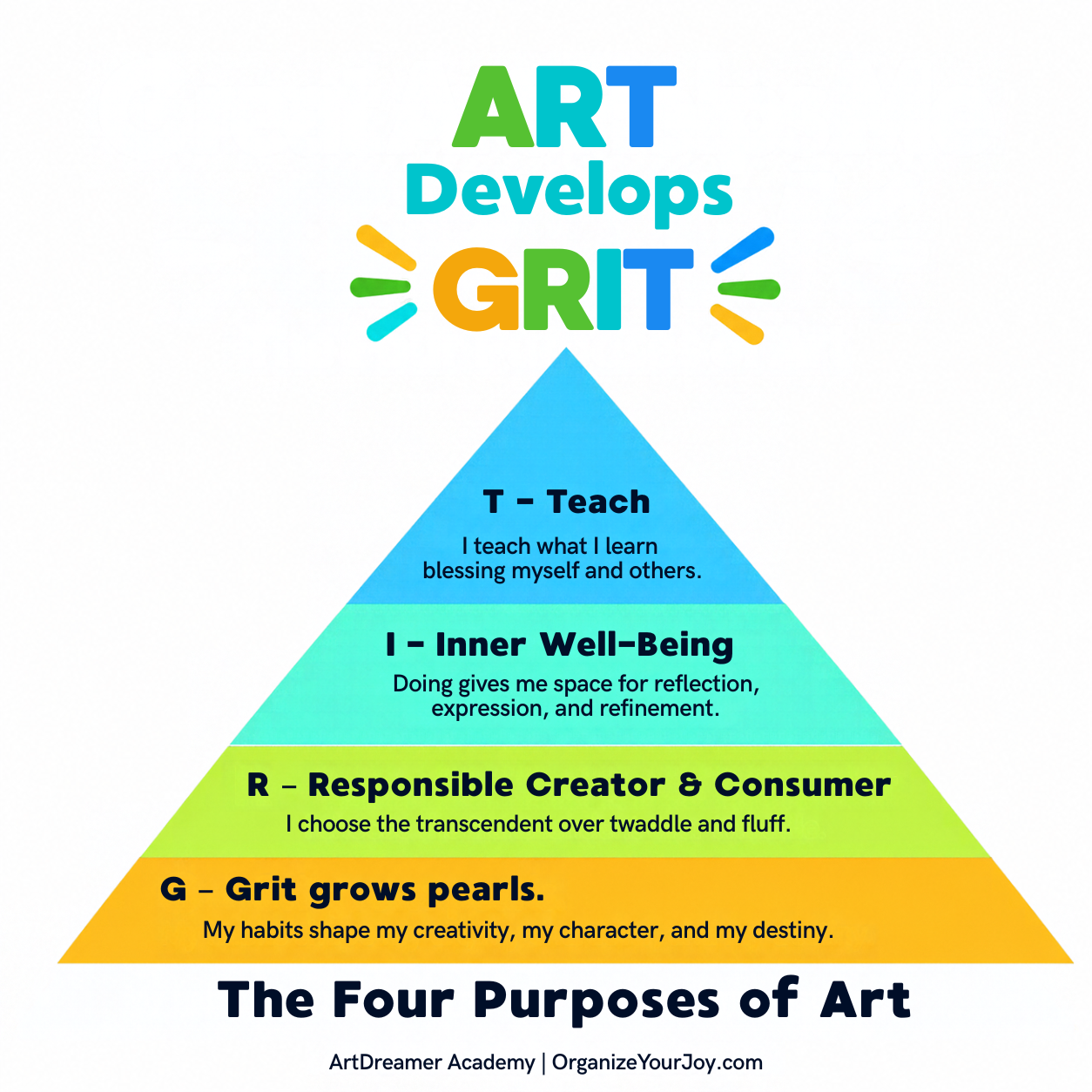
At ArtDreamer Academy, I teach four powerful benefits of art education for kids through one simple word: GRIT.
1. G — Grit Grows Pearls: Building a Growth Mindset
Practice, patience, persistence equals progress.
Imagine a child drawing a face and realizing the eyes are crooked. They can crumple the paper—or erase, study, adjust, and try again.
That little moment matters.
Art teaches children that mistakes are information. A difficult drawing, muddy watercolor, or lopsided pot can become an invitation to slow down and improve.
Remember, "Progress over perfection."
Over time, students develop patience, discipline, craftsmanship, and the courage to revise. These are essential growth mindset skills for kids.
Just as an oyster forms a pearl through irritation, challenges can help children develop grit.
2. R — Responsible Visual Creator & Consumer: Teaching Visual Responsibility
Images have power.
Children see hundreds of images every day through advertising, movies, social media, games, packaging, and entertainment. Some estimates say that we are viewing 4,000 images or ads a day. The images they consume can influence their attitudes, choices, and beliefs.
A student might look at an advertisement and ask, Why did the designer choose that? What is this image trying to make me feel, say, or do?
Suddenly, they are not simply consuming an image. They are thinking about it.
Art education develops visual literacy and critical thinking skills. Children learn to recognize symbolism, persuasion, beauty, manipulation, and meaning.
It also teaches responsibility as a creator.
What am I putting into the world?
Students can use their artistic gifts to communicate ideas, preserve history, strengthen families, serve communities, celebrate cultures, and prepare for creative careers.
3. I — Inner Well-Being: How Art Builds Confidence in Kids
Create. Reflect. Express. Grow.
Sometimes a child does not have words for everything they are thinking or feeling.
But they may be able to draw it.
I love the moment when a busy classroom becomes quiet because everyone is absorbed in creating. Pencils move. Brushes swish through water. Students concentrate on the next shape or color.
For a few minutes, the outside noise disappears.
Creative activities for kids can provide space for reflection, focus, emotional expression, connection, and confidence. Art also teaches children to notice beauty in the world around them. Five days a week I scripture journal and paint a little floral or galaxy border in my sketchbook, then go through the I PAINT acronym and write and reflect and center. My soul catches up with God and it makes a huge difference!
A peaceful pause matters.
Creating something with their own hands reminds students, I can learn. I can make something. I can improve.
These are some of the wonderful emotional and educational benefits of teaching art at home or in the classroom.
4. T — Teach What You Learn: Building Leadership Through Art
Learn it. Share it. Treasure it.
Have you ever watched a child learn something new and immediately turn around and teach it to someone else?
“Look! This is how you shade a sphere.”
“This is how you mix purple.”
“Watch what happens when you add water!”
That child is learning twice.
I tell my students: "What goes through you, sticks to you."
When students make things that matter or teach things they have learned, they strengthen their own understanding. Their confidence, craftsmanship, generosity, and leadership is transformed drop by drop as a pearl grows in luminescence.
Knowledge becomes more powerful when it is shared.
An artist can teach a sibling, help a classmate, create something for a neighbor, beautify a community, or inspire another artist.
Art becomes bigger than the artwork because it expands minds, hearts, and souls.
Art Education Makes a Difference in our Lives: We seek for the good, the true, and the beautiful
I don't want students to think art belongs only in the classroom or is reserved for a few talented superstars. We all benefit from having art in our lives, homes, families, and communities.
Art is in architecture, books, movies, museums, clothing, advertising, technology, product design, churches, homes, celebrations, and cultures throughout history.
A child studying pottery might suddenly discover ancient China. A drawing lesson might introduce a professional illustrator. A painting might become a gift for a lonely neighbor.
That is when art education becomes meaningful.
Whether through homeschool art curriculum or traditional classroom lessons, the goal is to connect students with history, advanced study, museums, professional artists, creative careers, community service, and family life.
Every Child Can Become an Artist!
Art is a skill—not a talent reserved for a lucky few.
You do not need an expensive studio or hours of free time to begin teaching art at home.
Start with a pencil.
Draw for ten minutes.
Practice one skill.
Then teach someone what you learned.
Simple homeschool art lessons and creative activities can develop grit, responsibility, inner well-being, and a desire to teach and serve others.
That is why I believe art education matters.
Looking for fun, beginner-friendly homeschool art lessons? Explore drawing, painting, and creative art courses for kids at ArtDreamer Academy | OrganizeYourJoy.com.
Click this link to read the Blog Article about 4 Benefits of Art Education for Kids: Building GRIT organizeyourjoy.com/blog/2026/10/19/4-benefits-of-art-education-for-kids-building-grit