By Krystal Meldrum
A picture is worth a thousand words!
Artist Minerva Teichert once expressed her desire to create paintings that “those who run may read.” She wanted people to understand her messages simply by looking at her artwork.
That is the power of visual communication!
Art can teach, inspire, persuade, and communicate truths without a single written word.
But how do we teach children to create meaningful artwork?
I believe we must teach them The Architecture of Art—the foundational principles that help artists transform imagination into masterpieces.
1. Art Is a Language Everyone Can Learn
Teach the skills. Liberate the artist!
Imagine teaching children to read by handing them a pile of alphabet letters and telling them to figure it out!
We wouldn't do that.
We teach phonics, words, sentences, paragraphs, and eventually books.
Yet art students are often given craft projects without learning the foundational skills of drawing, painting, composition, and visual communication.
I believe art deserves the same thoughtful instruction we give reading, writing, mathematics, and music.
Art is a learnable skill!
2. Give Students the Tools to Soar
Strong foundations create creative freedom.
When I was in junior high and high school, I desperately wanted to paint the beautiful images I could see in my imagination.
But I didn't know how!
I felt like a bird trapped in a cage, longing to fly.
Finally, in college, I learned figure drawing, perspective, light and shadow, and other foundational art skills.
My teachers gave me the tools I needed to soar!
That's what I want to give my students.
Not simply projects to complete, but skills they can use for a lifetime.
3. Begin With Your Why
Purpose gives your creativity direction.
Before teaching students how to create, I want them to consider why they create.
How can your artwork make the world a better place?
Artists communicate through messages, stories, symbols, and visual metaphors.
For example, imagine a painting featuring two women. One gazes at her reflection beside a narcissus flower, while another gathers grain from a field.
The contrasting symbols could communicate a message about vanity, industry, and inner character.
Understanding symbolism helps students become responsible visual creators and consumers.
Images have power. Use them for good!
4. Build the Foundation: The First Nine Principles
Learn the language of art.
Just as a building needs a strong foundation, artists need essential knowledge and skills.
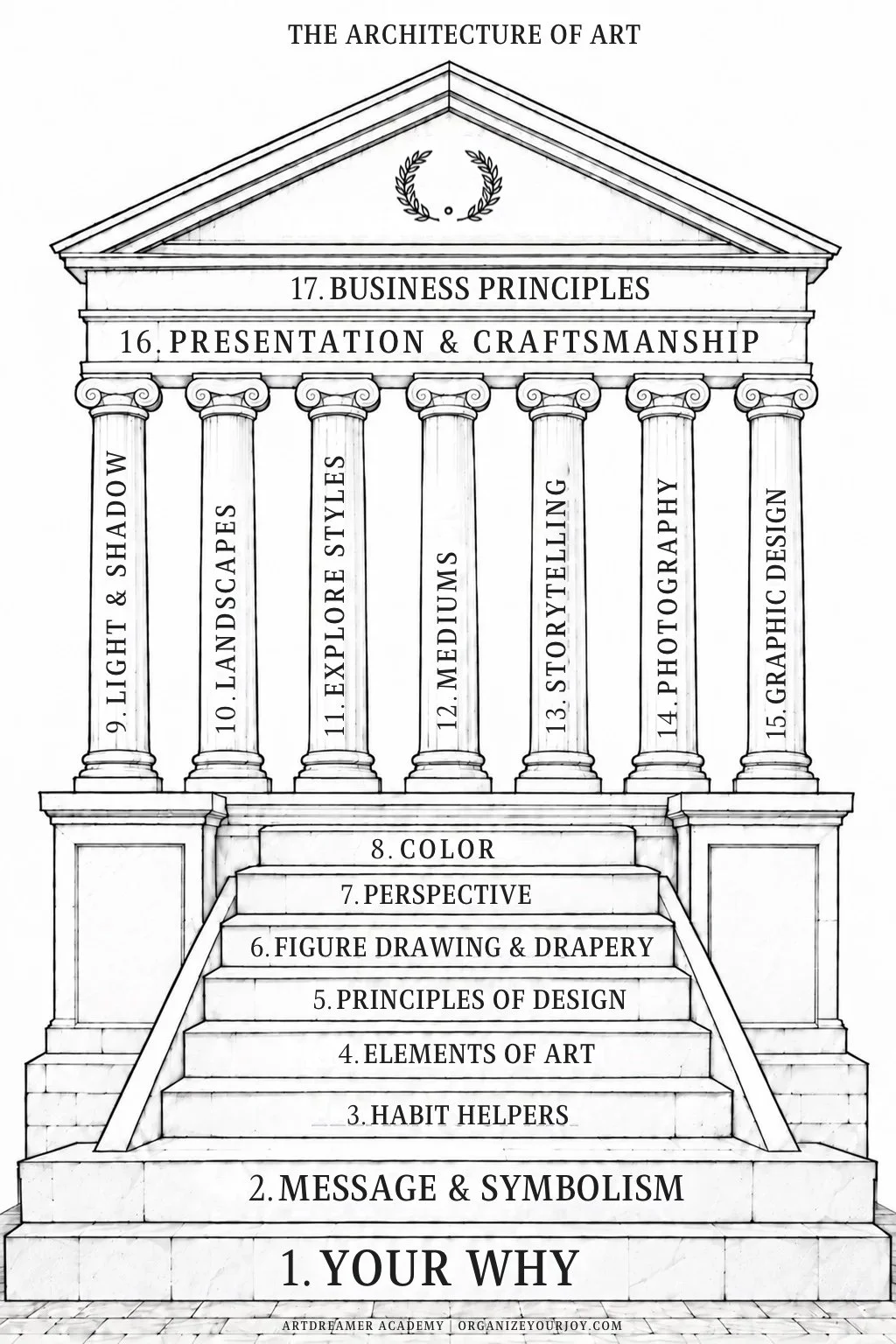
My Architecture of Art framework begins with nine principles:
Your Why — Discover your purpose.
Message & Symbolism — Communicate meaningful ideas.
Habit Helpers — Develop consistent creative routines.
Elements of Art — Master line, shape, form, value, color, texture, and space.
Principles of Design — Organize artwork through balance, contrast, emphasis, and unity.
Figure Drawing & Drapery — Understand anatomy, proportion, and fabric.
Perspective — Create believable spaces.
Color — Communicate mood and emotion.
Light & Shadow — Create form, depth, and atmosphere.
These principles give artists the vocabulary and technical skills to communicate visually.
5. Develop Your Artistic Voice
Master the foundations. Explore the possibilities!
Once students understand the fundamentals, they can develop their creativity through the next eight principles:
Landscapes — Combine perspective, atmosphere, and composition.
Style — Develop your unique artistic voice.
Mediums — Explore different materials and techniques.
Storytelling — Communicate through characters, settings, and narratives.
Photography — Capture references and document artwork.
Graphic Design & Typography — Combine words and images effectively.
Presentation — Frame, photograph, and display artwork professionally.
Business Principles — Learn to price, market, sell, license, and teach art.
These skills prepare students to create artwork for personal enjoyment, service, communication, or a creative career.
Experimentation is wonderful! But it becomes even more powerful when students have the skills to experiment intentionally.
6. Art Gives Students Roots and Wings
Build strong foundations. Let creativity soar!
Art enriches our lives through beauty, self-expression, healing, connection, influence, and even income.
We live in a visual world. Images influence what we believe, value, purchase, and become.
I want my students to understand that their creativity can bless their families, communities, and the world.
The Architecture of Art gives students a roadmap for continued learning long after they leave my classroom.
My greatest hope is that the beautiful ideas in their minds will no longer feel trapped there.
I want to teach them how to fly!
💙 Art is not a talent, it’s a skill that anyone can learn!
Discover step-by-step drawing, painting, and creative courses at ArtDreamer Academy | OrganizeYourJoy.com.